
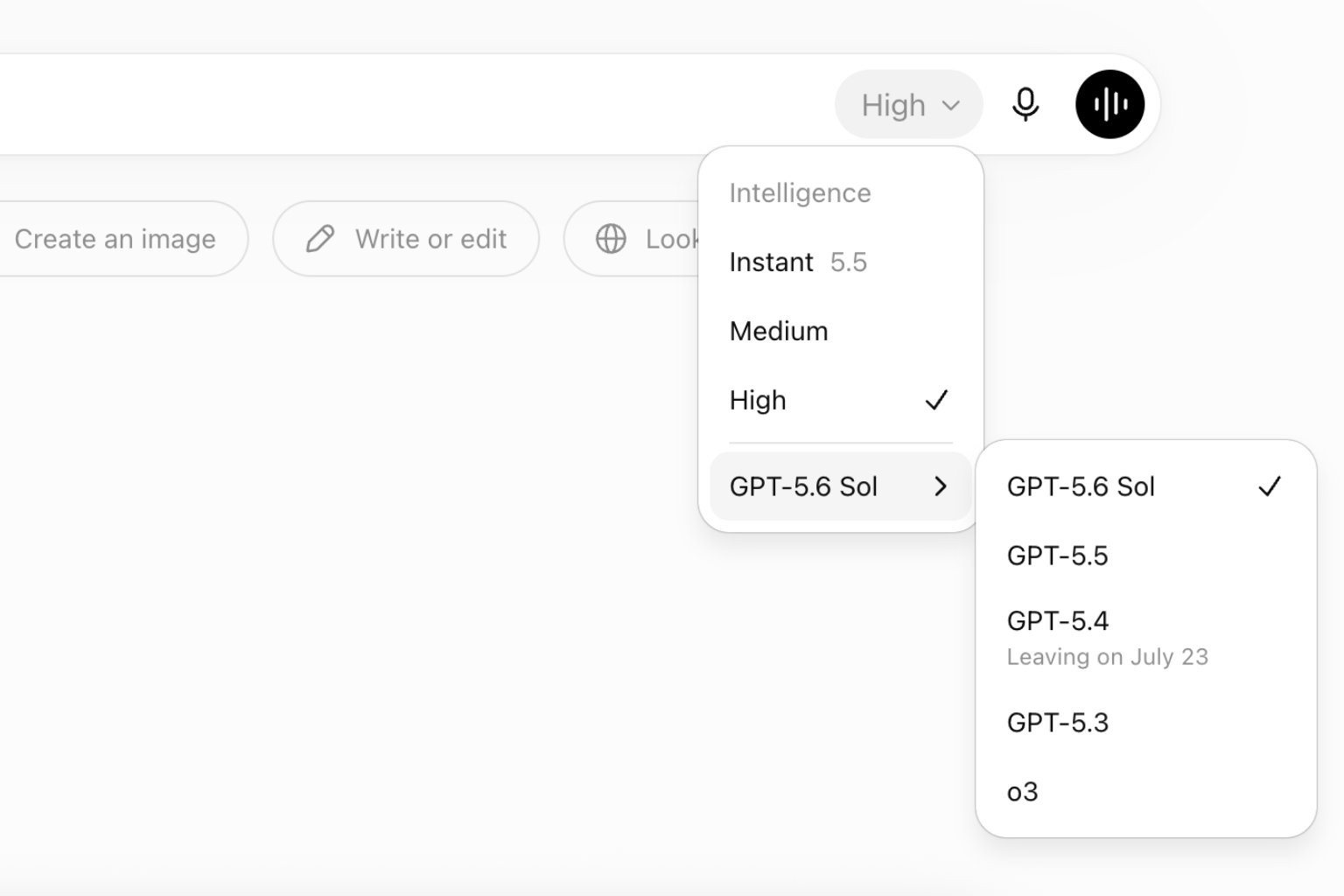
OpenAI released GPT-5.6 Sol on July 9, 2026, as the flagship model in a new three-tier family. Sol sits at the top for difficult professional work, Terra balances intelligence and cost, and Luna targets fast, high-volume workloads.
The most important change is not a single benchmark. GPT-5.6 is designed to get more useful work from every token while giving users new ways to spend extra compute when a task demands it. Sol adds stronger coding, computer use, design judgment, and long-horizon execution, plus max reasoning and a multi-agent ultra setting for the hardest workflows.
If you build AI products, use coding agents, or delegate research and operational work to AI, this guide covers what changed, what OpenAI’s benchmarks show, how the API is priced, and whether GPT-5.6 Sol is the right upgrade.
You can also explore the full technical profile on our GPT-5.6 Sol model page.
What Is GPT-5.6 Sol?
GPT-5.6 Sol is OpenAI’s new flagship model for complex professional work. It is the highest-capability member of the GPT-5.6 family:
- Sol is the flagship for complex reasoning, coding, research, and long-running agentic work.
- Terra is the balanced tier, with performance OpenAI says is competitive with GPT-5.5 at a lower price.
- Luna is the fastest and most affordable tier for cost-sensitive, high-volume workloads.
The names are more than temporary codenames. OpenAI says Sol, Terra, and Luna are durable capability tiers that can advance on their own cadence, while the number identifies the model generation.
For developers, the canonical API model ID is gpt-5.6-sol. The shorter gpt-5.6 alias also routes to Sol. All three GPT-5.6 tiers are available through the OpenAI API, while availability in ChatGPT, ChatGPT Work, and Codex depends on the user’s plan.
What Is New in GPT-5.6 Sol
1. Stronger Coding and Long-Horizon Execution
OpenAI describes GPT-5.6 Sol as its best coding model yet. The company reports a score of 88.8% on Terminal-Bench 2.1, compared with 85.6% for GPT-5.5, and 72.7% on DeepSWE v1.1, compared with 67.0% for GPT-5.5.
On the Artificial Analysis Coding Agent Index, Sol with max reasoning scores 80, ahead of GPT-5.5 at 76.4. OpenAI also reports that Sol reaches that result with fewer output tokens, less time, and lower estimated cost than some competing frontier models.
The practical improvement is persistence. GPT-5.6 is built to keep working through terminal operations, codebase navigation, testing, tool calls, and revisions instead of treating each step as an isolated prompt.
2. Max Reasoning for the Hardest Problems
GPT-5.6 introduces max, a reasoning-effort level above xhigh. It gives the model more time to explore alternatives, run checks, and revise its approach before producing a result.
That does not make max the right default for every request. Routine work will usually be faster and cheaper at a lower effort level. It is most useful when the cost of a weak answer is higher than the extra latency and token usage, such as difficult debugging, technical research, or multi-stage planning.
3. Ultra and Parallel Multi-Agent Work
The new ultra setting goes beyond giving one model more time. It coordinates four agents in parallel by default, then combines their work into a final result.
OpenAI reports that Ultra raises Sol’s Terminal-Bench 2.1 score from 88.8% to 91.9% and its BrowseComp score from 90.4% to 92.2%. Those numbers should not be compared as if Ultra were a standard single-model request: it uses multiple agents and more total tokens in exchange for stronger results and a faster time-to-result on suitable parallel tasks.
In ChatGPT Work and Codex, Ultra availability varies by plan. API developers can build similar workflows with the multi-agent beta in the Responses API.
4. Programmatic Tool Calling
Programmatic Tool Calling lets GPT-5.6 write and run lightweight programs in memory to coordinate tools and process intermediate results.
Instead of sending every tool response back through the model in full, the model can filter data, retain what matters, monitor progress, and decide what to do next. This can reduce model round trips and token usage in tool-heavy workflows while keeping the execution adaptive.
OpenAI says this approach is compatible with Zero Data Retention requirements in the Responses API.
5. Better Computer Use and Design Judgment
GPT-5.6 Sol posts substantial gains on evaluations that test browsing and computer operation. OpenAI reports:
- 90.4% on BrowseComp in standard mode and 92.2% with Ultra
- 62.6% on OSWorld 2.0, up from 47.5% for GPT-5.5
- 70.6% on BenchCAD, up from 44.4% for GPT-5.5
OpenAI also highlights a qualitative improvement in design judgment. Sol is better at turning high-level instructions into polished interfaces, inspecting rendered results, and refining both visual and functional details before handing the work back.
That same capability carries into presentations, documents, and spreadsheets. The model is designed to follow reference templates more faithfully, preserve layout systems, and produce more finished work rather than raw content that still needs extensive cleanup.
6. Stronger Science and Cybersecurity Performance
GPT-5.6 Sol shows broad gains across scientific and cybersecurity evaluations. OpenAI reports 28.7% on GeneBench Pro, compared with 12.0% for GPT-5.5, and 59.9% on LifeSciBench, compared with 50.4%.
In cybersecurity, Sol scores 73.5% on ExploitBench, compared with 47.9% for GPT-5.5, and 71.2% on SEC-Bench Pro, compared with 45.8%.
These are dual-use capabilities. OpenAI applies additional safeguards and access controls to higher-risk cyber tasks while offering a Trusted Access for Cyber program for qualified defensive-security professionals.
GPT-5.6 Sol API Specs
| Specification | GPT-5.6 Sol |
|---|---|
| API model ID | gpt-5.6-sol |
| API alias | gpt-5.6 |
| Input | Text and images |
| Output | Text |
| Context window | 1,050,000 tokens |
| Maximum output | 128,000 tokens |
| Knowledge cutoff | February 16, 2026 |
| Reasoning effort | None, low, medium, high, xhigh, and max |
| Standard input price | $5 / MTok |
| Cached input price | $0.50 / MTok |
| Standard output price | $30 / MTok |
Sol supports streaming, function calling, and structured outputs. In the Responses API, its supported tools include web search, file search, image generation, code interpreter, hosted shell, apply patch, computer use, MCP, and tool search.
OpenAI recommends the Responses API for the full GPT-5.6 tool and agent experience, although the model also supports Chat Completions.
GPT-5.6 Pricing
The GPT-5.6 family is priced per million tokens:
| Model | Input | Cached input | Output |
|---|---|---|---|
| GPT-5.6 Sol | $5 | $0.50 | $30 |
| GPT-5.6 Terra | $2.50 | $0.25 | $15 |
| GPT-5.6 Luna | $1 | $0.10 | $6 |
There are two details that matter when estimating real production cost:
- Long-context requests cost more. Prompts with more than 272,000 input tokens are billed at twice the input rate and 1.5 times the output rate for the full request.
- Cache writes have a separate rate. GPT-5.6 cache writes cost 1.25 times the uncached input rate, while cache reads receive a 90% discount. OpenAI also introduced explicit cache breakpoints and a minimum cache life of 30 minutes.
Sol has the same headline $5/$30 standard token price as GPT-5.5. The economic case for upgrading therefore depends on whether its higher task success rate and token efficiency reduce retries and total work per completed task.
For routine transformations, classification, extraction, and high-volume requests, Terra or Luna may be more economical. Sol earns its price on work where planning depth, persistence, tool use, and output quality matter.
GPT-5.6 Sol vs GPT-5.5
The following figures are OpenAI-reported evaluation results. Ultra results use a multi-agent configuration and are listed separately.
| Benchmark | GPT-5.6 Sol | GPT-5.6 Sol Ultra | GPT-5.5 |
|---|---|---|---|
| Terminal-Bench 2.1 | 88.8% | 91.9% | 85.6% |
| DeepSWE v1.1 | 72.7% | - | 67.0% |
| BrowseComp | 90.4% | 92.2% | 84.4% |
| OSWorld 2.0 | 62.6% | - | 47.5% |
| BenchCAD | 70.6% | - | 44.4% |
| GeneBench Pro | 28.7% | - | 12.0% |
| ExploitBench | 73.5% | - | 47.9% |
The strongest gains are in computer use, design-oriented workflows, cybersecurity, and long-running tool use. GPT-5.5 remains capable, but Sol is the more natural default when the task is complex enough to justify frontier-model pricing.
Migrating to GPT-5.6 Sol
For most API users, the first test is straightforward: replace the existing model ID with gpt-5.6-sol in staging and run representative workloads.
A practical migration checklist:
- Use
gpt-5.6-solwhen you want to pin the Sol tier explicitly, orgpt-5.6if OpenAI’s moving alias fits your versioning policy. - Test several reasoning-effort levels instead of defaulting every request to
max. - Recalculate costs for prompts above 272,000 input tokens.
- Test prompt caching with the new cache-write price and explicit breakpoints.
- Validate tool-heavy workflows in the Responses API, especially if you want Programmatic Tool Calling or multi-agent behavior.
- Compare task completion cost, not only cost per token. Include retries, output length, tool calls, and human cleanup.
- Keep Ultra results separate from standard-mode results when evaluating quality, latency, and spend.
Who Should Use GPT-5.6 Sol?
GPT-5.6 Sol is a strong fit for:
- Software engineers and coding-agent teams working across large repositories, terminals, tests, and long-running implementation tasks.
- Agent builders who need reliable tool orchestration, adaptive workflows, and fewer model round trips.
- Operations, finance, and consulting teams producing polished reports, presentations, spreadsheets, and other professional deliverables.
- Product and design teams turning natural-language requirements into functional interfaces and reviewing rendered output.
- Researchers running complex browsing, analysis, scientific, or technical workflows.
- Defensive-security teams doing authorized code review, vulnerability research, threat modeling, and patch validation.
Terra or Luna will often be a better choice for simpler work where cost and throughput matter more than maximum capability. Sol is built for the tasks where a failed run, missed detail, or unfinished workflow costs more than the model call itself.
Safety and Availability
GPT-5.6 is available across ChatGPT, Codex, and the OpenAI API, with access varying by product and subscription.
In ChatGPT, Plus, Pro, Business, and Enterprise users can access Sol through medium and higher effort settings. Pro and Enterprise users can also select Sol Pro for the highest-quality results on complex work.
In ChatGPT Work and Codex, paid plans can choose among Sol, Terra, and Luna. max and ultra availability depends on the product and plan.
OpenAI says GPT-5.6 has its most robust safeguards to date. The company combined human red teaming, external expert testing, and large-scale automated evaluations before general availability. Its system card classifies GPT-5.6 as more capable in biology and cybersecurity than earlier models but below the company’s Critical capability threshold in both areas.
Build AI Tools With GPT-5.6 Sol and Appaca
A frontier model is most useful when it is connected to real workflows, data, and people.
Appaca is an AI workspace for operations teams. Describe the internal tool you need and Appaca builds it with a database, integrations, and AI co-workers ready for your team.
GPT-5.6 Sol’s profile is particularly well suited to tools that need to work through messy, multi-step tasks: research assistants, operational reporting agents, document processors, internal knowledge tools, and workflow apps that inspect their own output before finishing.
You can review its pricing, context window, and strengths on the GPT-5.6 Sol model page, or compare it with other providers in the AI models directory.
So,
GPT-5.6 Sol is OpenAI’s new flagship for difficult professional work. Its biggest improvements show up where modern AI systems often struggle: staying productive across long workflows, coordinating tools, operating software, applying design judgment, and turning rough inputs into finished deliverables.
The headline API price is unchanged from GPT-5.5 at $5 per million input tokens and $30 per million output tokens. What changes is the capability available at that price, plus the option to spend more compute through max and multi-agent workflows when a task warrants it.
Use Sol for the hard work. Use Terra or Luna when throughput and cost matter more. Most importantly, benchmark the complete workflow on your own data instead of choosing from a leaderboard alone.
The primary technical details and benchmark figures in this article come from OpenAI’s GPT-5.6 release announcement and GPT-5.6 Sol API documentation.